I was recently asked to look at a change one of our developers made to RavenDB. He was chasing a particularly slow query with spatial sorting (a “find me all the nearest Thai restaurants” style of query). He found the root cause and had a fix ready. The fix gave us a 25% improvement in query processing time, and the change was about 15 lines of code.
A few years ago, I would have said: great job, merge it, ship it, let customers enjoy the faster queries. But I got a hunch that we could do something different. We asked the AI model to try it out. It took a non-trivial amount of work to even test that, while in the past, it would have taken a few days just to try it out.
The model was able to complete the spike while we were talking about why this should be a good approach and the architectural-level aspects that were driving it.
The result of that spike was an improvement of 12x. Not 12%. Twelve times faster. A 25% improvement is a wow;a 1,100% improvement is damn. In essence, we took a shortcut a couple of decades ago and had to pay a lot more than we could have.
Note that a 15-line fix is local, easy to understand and verify. A structural change like this is… not. We also have to deal with backward compatibility concerns (we had to change the index format), verify that we get the same output in both cases, etc.
Along the way, we found three separate bugs that had been in the product for 10 to 15 years. They're all in very weird edge cases. What happens when you sort on a spatial field that doesn't exist?
If a document has no spatial value, we would treat the missing value as zero distance, which means it is the closest result. I can argue that this is the correct behavior, but not convincingly.
The PR went from 15 lines of code to about a thousand. Review time for that went from under 10 minutes to over an hour.
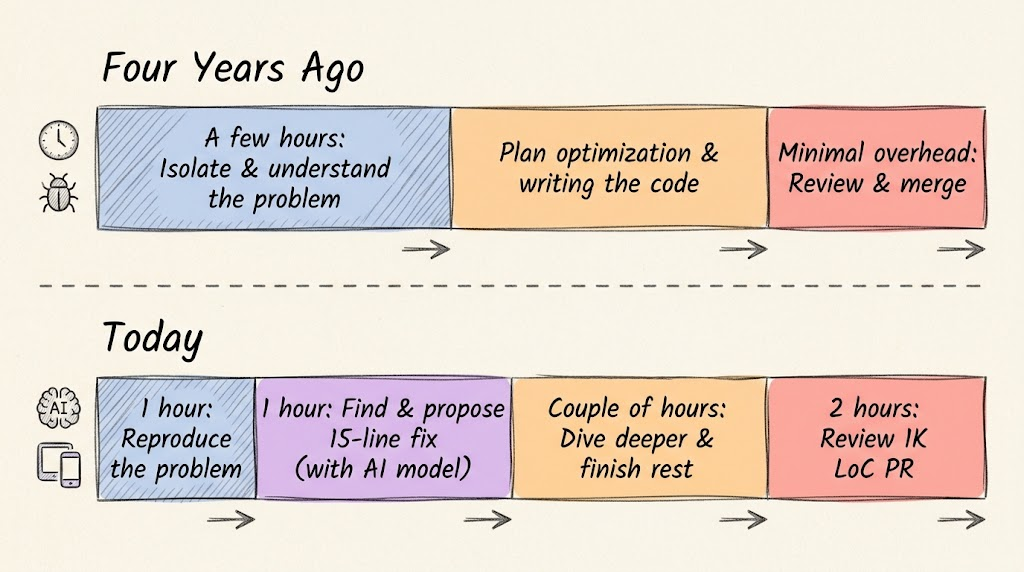
Compare this to the same task four years ago: a few hours to isolate and understand the problem, a couple of hours to figure out how we could optimize this, write the code, etc. The overhead of actually reviewing the code and merging it would be pretty minimal.
Today, it took an hour to reproduce the problem, another with the model to find & propose the original 15-line fix. Then we dove deeper into this and did the rest in another couple of hours. The 1K LoC PR would take two hours to review.
Interestingly enough, I don’t think we would have hit on the 15-line fix if we had been working manually. That took advantage of a library function I didn’t even know existed. We would have headed directly to the proper fix we ended up with.
That leads to a few observations about the process. The quick fix with the AI would have delivered an inferior end result. It is funny when I say that a 25% improvement is inferior, but it would have been in this case.
The other aspect is that each decision we made along the way made sense, but we ended up with something that was big. To the point that you need to meditate over the code to understand it.
This is a very small and focused change, mind. And it grew from 15 lines to 1K. We are seeing the size of PRs grow from a few hundred to many thousands of lines of code.
All of that pushes the complexity into the review process. And for long-lived software, review is not something you can skimp on. RavenDB has been around since 2009. Code we merge today is code we will be supporting and reasoning about for the next decade.
There is a wide spectrum of opinions on this right now. Some people say they never read the code; some have an agent review it. Others insist on going through every line, and that is where I stand.
The code that goes into RavenDB gets a manual review by a person who understands everything about the system. Not just whether the code is correct, but how it interacts with all the other stuff we have, the history behind it, and the things that are not in the diff.
Productivity? Where is it at?
As an industry, we expected AI to make us dramatically faster. If AI writes 90% of the code, sometimes 100%, shouldn’t we be shipping more often? And better software as well, no?
Every developer I've talked to says the same thing: I cannot not use AI. The benefits are too high to give up. I have seen people who left the IDE entirely and some who just use AI to explain and reason about the code, but everyone is using AI in some capacity. But we aren't seeing the change in productivity that everyone predicted.
I think a big part of the answer is in the story above. We aren't doing the same work faster. We're doing more work, arguably better work. We find opportunities we would never have considered, because the cost of checking a hunch dropped significantly. The cost of accepting the answer didn't decrease; in fact, I would argue that it became much higher.
To be clear about the scale of this: RavenDB did not suddenly get 12 times faster across the board. As much as I wish a 1K PR could do that. A single scenario got dramatically better. That is great, but it is also more code, more behavior to understand, and more surface area to maintain.
When we keep going like that, we end up with better software overall, but also a much larger mass of code to work with. It also means much more effort from the people who actually have to deliver it.
I think that we’ll see major shifts in how we build and maintain software, but at the same time, I think that the key fundamentals haven’t really changed. In the past quarter, RavenDB (the company, not the software) hired more R&D staff than we did in the past two years, to give you some context.
There is going to be a greater need for developers than ever, and even more digitalization of the world.
I started RavenDB in a spare bedroom, because of a problem that wouldn't let me sleep. Everywhere I looked, applications were fighting their own database. ORMs papering over a model that didn't fit. Indexes missing or just bolted on after production failures, without attention or concern to how to do this properly.
That was the common situation in the industry; accepted because databases required a lot of expertise and no one had time to do the right thing with the next release date looming. The industry's answer was always another layer of tooling on top of a design that was already wrong. So I built a database where those things were expected, that would behave properly even if it didn’t have a full time babysitter to make sure it survived production.
Twenty years later, I'm looking at the same shape of problem again.
The same feeling, a second time
In the past couple of years, we built RavenDB's AI capabilities and we've spent the last year helping our customers launch complex AI initiatives. Not just the sorts that make for a cute demo. Stuff that runs in production and intelligently serves hundreds of thousands of users. The kind that has to work in the field, in front of real users, and just keep ticking.
Looking at the overall AI landscape, I think we, as an industry, have a problem. I have not seen this much effort spent on bringing so little value since 2008. That is the sort of thing that makes my fingers itch to go ahead and fix it.
The numbers say the same thing. Demos are easy, and a weekend gets you something that impresses the room. Getting that same thing into production takes 12 to 18 months of plumbing work and endless testing, and out of a hundred initiatives, about five make it.
“Gartner expects more than 40% of agentic AI projects to be canceled by the end of 2027, citing escalating costs, unclear business value, and inadequate risk controls”
Most enterprises have their data sitting in existing systems and databases. All of them have been running for a decade or more. The entire company relies on those systems, very few people actually understand how they work and their internal interactions. Nobody is volunteering to touch them. The phrase “there be dragons” was coined specifically for those kinds of situations.
At the same time, there is an intense pressure from the market and management to introduce AI in all things. That typically means that you need to bring in new AI-ready infrastructure. Modifying the core systems of the business is tricky. No wonder that those projects take so long, or fail so often.
Remember, it's not just one system either. Working out a customer's status at a bank means the checking balance from one system, the mortgage from another, the credit card activity from a third. You also have to consider the interactions between all those systems. To bring that to the world of AI is a huge leap.
The gap you have to cross is beyond just throwing data at a Large Language Model. It's a data organization, understanding, and governance one. You have to first get your house in order before you can take the first real step.
So we built Quill
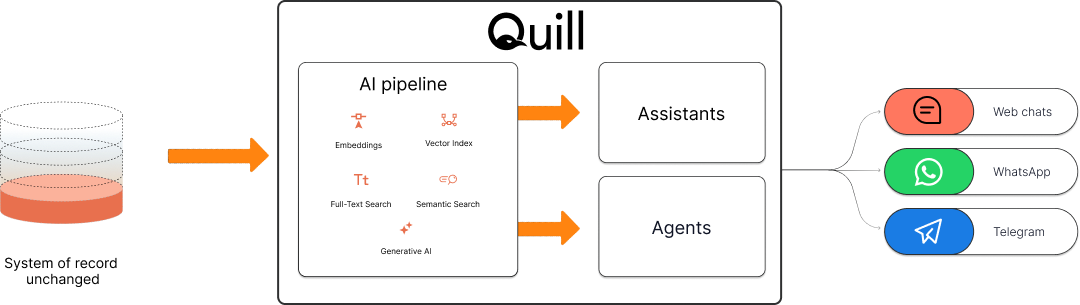
Quill is an AI Context Layer. It sits between your existing databases you already run and it provides the AI infrastructure that you need to build sophisticated AI capabilities in your organization.
Quill takes upon itself to do the work most teams are currently doing by hand.
A typical AI project requires you to first get your data governance story in order, understand how to effectively utilize Large Language Models and keep chasing the latest innovations. That previous statement, translated to calendar time, is about two years. In work-years, it is usually measured in multiple decades.
Quill changes this in a dramatic fashion, here is how it works, at a high level:
Point Quill at your existing databases (Postgres, SQL Server, MariaDB, MySQL).
Tell Quill what aspects you are interested in, and it will deal with the minutia of turning your existing data into the proper shape for AI to consume and work with.
Describe what sort of AI capabilities you want (AI bank teller, for example), and Quill will generate that for you.
What is actually happening behind the scenes is that Quill is pulling and transforming the data from your existing databases into RavenDB. This is done on a continual basis, so the data is always up to date. Once the data is inside RavenDB, you can then apply all of RavenDB’s own AI capabilities. Such as vector search, embedding generating, Generative AI and AI Agents.
Building on top of the proven RavenDB infrastructure, you get to skip a lot of the hassles in properly delivering an AI project. Details like Bring Your Own Model, audit trails, rate limits, vector indexes and more.
Most importantly, Quill allows you to remain in control at all times. Your data never leave your servers, you don’t have to trust a cloud service with your most precious assets. You can control what information will be available to the AI model. Finally, both RavenDB and Quill take the approach that the AI model is not a trusted entity.
Typical AI projects use MCP connectors to expose your system to the AI model. That puts the AI itself in the driver’s seat. Quill takes the opposite approach, the AI is there to facilitate and provide the intelligence. It is never in control, and it is intentionally limited in what it can see and do.
Quill takes the notion of security much more seriously than merely using row-level permissions. Any interaction with the model is scoped to seeing just the information that the model should see in its current role as an agent of the user.
Quill Design Philosophy
Quill assumes that the AI model is inherently vulnerable. Quill’s approach is to limit the scope of what the AI can access and the actions it can perform. The AI is considered to be an agent of the user, not the organization.
If a user manages to prompt-engineer the AI agent, they are still behind the same security door, with no privileged access possible.
Quill’s AI capabilities allows you to immediately deploy agents in your application and in channels such as Telegram, Slack, or Discord.
What you end up with
Agents working from data that always is up to date, seeing only what they're cleared to see, running on your own servers. That's the whole thing.
The idea with Quill is that you can rapidly AI enable your systems in a safe and reliable manner. Instead of taking years to deliver AI projects, you can be in production in mere weeks.
More importantly, Quill isn’t built to be just a nice demo. Quill was built to be the AI infrastructure that you need to scale your AI in as they grow in complexity and scale easily with a huge number of users.
Quill is built on top of RavenDB’s proven AI infrastructure. Running AI agents in production, serving hundreds of thousands of users in a highly regulated industry.
I spoke earlier about the ease of onboarding. Just point Quill to your existing databases, click “Next” a few times and you have a running AI agent that you can immediately start working with. Quill matters because it is there to handle all of the logistics around that, and all the “-ities” that you need to concern yourself with.
From built-in memory so your agents retain continuity between interactions, to audit trail so you can see past conversation, handling compaction, guardrails, mutli-agents and multi-channel conversations.
Quill allows you to build a simple AI assistant that can access the relevant data to answer questions. You can then expand on that to build sophisticated AI agents that take actions on behalf of the user.
You have the space and ability to grow your AI capabilities in an iterative manner, without having to invest several work-years into a project with high probability of failure. We are confident that you’ll be able to go from zero to production deployed AI capabilities within weeks. Quill is offered with a 3 months unlimited free trial.
Quill is generally available today. Go build your first agent now.
I’m currently working on a pretty deep optimization cycle in how RavenDB and Voron (its storage engine) handle I/O. The idea is to be able to squeeze more performance out of the system by being able to utilize a lot of moving pieces at once (parallelizing compute, durable I/O, async I/O, etc.).
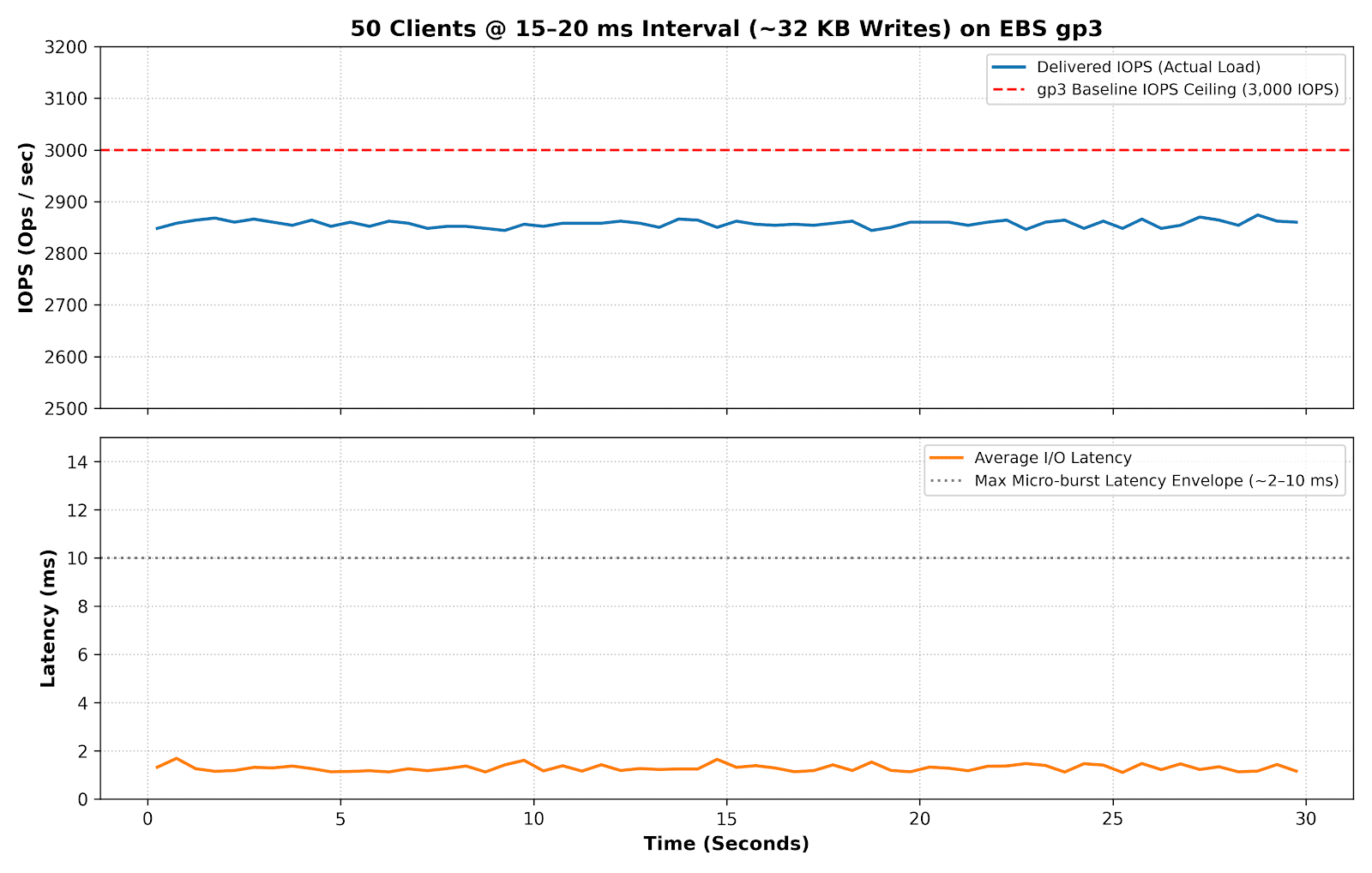
At the end of the day, however, it all must reside on disk, of course. That means that I’m essentially seeing how close I can dance to the edge of the capabilities of the system. For example, let’s consider AWS GP3 drives. They offer 3K IOPS and 125MB/sec on the basic plan.
We have 50 clients, each generating a request every 15 - 20 ms and writing ~32KB each. This is the kind of load that they’ll generate on the system. Here is what this looks like:
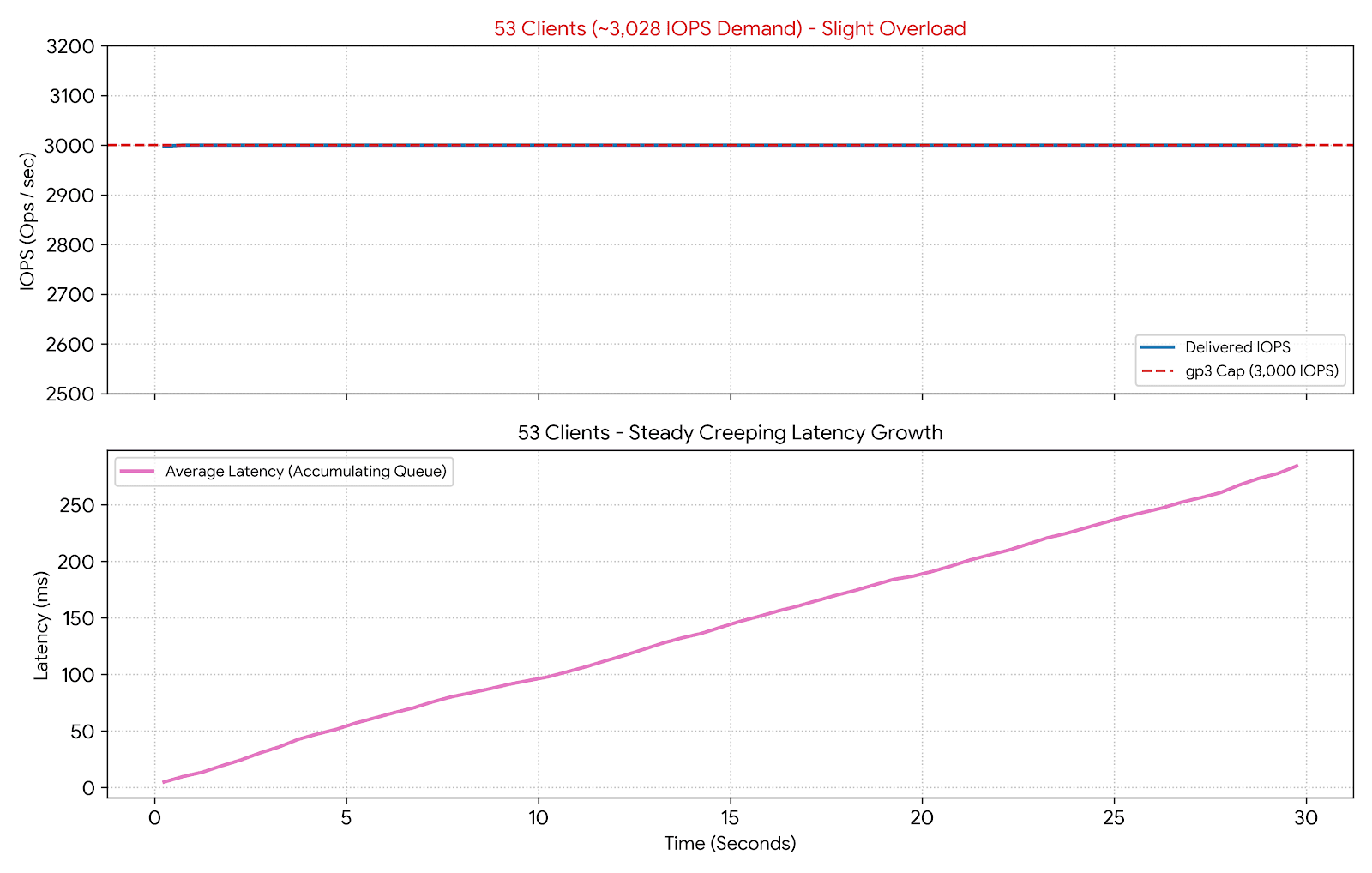
Now, let’s add just 3 additional clients to the mix, add just enough to hit the limit (not even grossly exceed it!). Here is what this looks like:
Note that in very short order, we moved very quickly from < 2ms to > 250 ms. That is the kind of dangerous tipping point that causes the system to just fall over and die.
As a database engine builder, I have to be really conscious about those details, since it is better for us to start rejecting or slowing requests before we saturate the disk like that. When this happens, you often can end up with a system that is simply unable to perform any I/O.
When that happens, you start using more memory (and buffers). When you run out of memory, the OS will decide to try to swap to disk. But the disk is busy. I/O starvation like that can turn into “the entire machine just locked up and doesn’t respond to anything” in very short order.
I have shown you AWS GP3 for a reason; it has consistent behavior. But there are other models. AWS GP2, Azure’s Premium SSD v1, and GCP’s Standard PD all have a different mechanism.
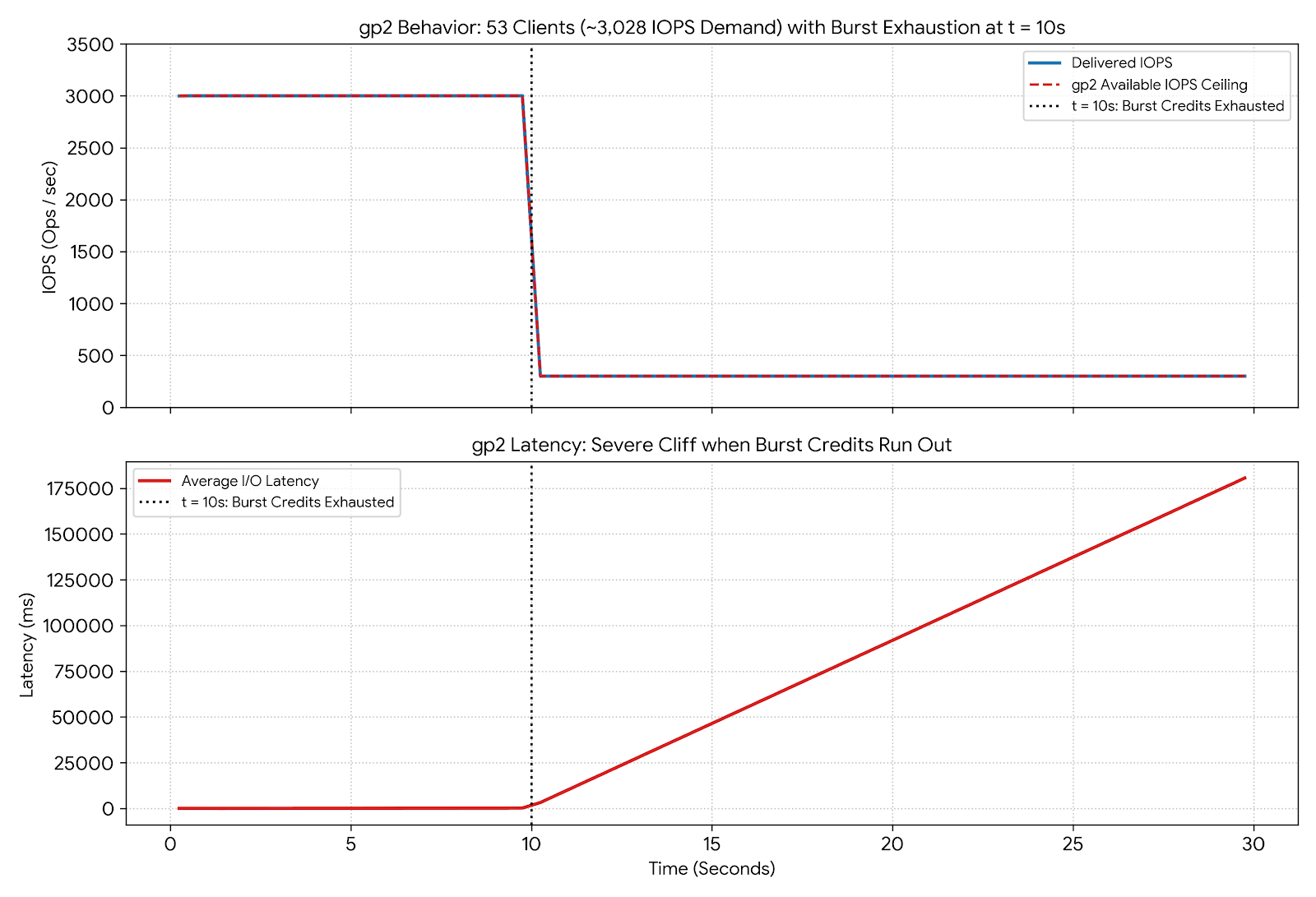
You get burstable I/O - if you need to copy a large file, for example, the system will let you exceed those limits (for a while). You get a certain allowance that allows you to smooth over jumps in usage. That can be very nice, until you realize that this is what this does to the system:
I strongly dislike those sorts of disks, because there is very little that you can do to actually properly prepare for these scenarios. At one moment, you are running smoothly, and suddenly all your I/O is yanked out of your hands. You don’t have time to apply back pressure, for example. It’s like going for a jog and at the 800m line you are wearing lead shoes.
As they say, as a result: hilarity ensues.
All of this exposition is to discuss the details of what I’m trying to do. The work we are doing is to try to make the most of the hardware capabilities we have, and at the same time, be able to apply back pressure on our clients so we can properly perform at high scale.
I’m doing this work with Claude Fable 5. At the time of this writing, this is one of the top frontier models. I find it quite an interesting experience, to be honest. It is like working with an idiot savant, with an emphasis on both parts at once.
It can be incredibly capable of wedging itself into weird shapes. The reason for this post is that I’m currently waiting for a benchmark run to complete and contemplating this statement that it based a whole design on:
bandwidth = maximum size/duration ever observed (a flood cannot make a single write exceed the device's real throughput, so congestion can't inflate this either).
As you can see, this assumption (which was “load bearing” for the entire design) is quite wrong. It is also the sort of thing that caused me to have a jump scare moment when I saw that. No, we do not make these sorts of assumptions here. Don’t ask me why; I got the scars from that.
The interesting part of this assumption is that it is entirely reasonable to make. If I heard that statement from a developer, I would correct that, but it would make sense why they think that.
For a frontier model (that is currently busy doing this exact performance work, I should add), that was surprising. It showed how a small assumption can generate a pretty bad result. To be fair, I had my own similar scenario (which took ~10 years to fix).
I can say that you can expect some nice goodies out of this work.
The key premise in those sorts of models is that you can feed the model text of any size, and it will automatically handle generating embedding vectors, smart chunking, providing context, etc.
I ran into this recently and was curious to see how this can work. In particular, since RavenDB handles both embedding generation and vector search, I decided to do a full evaluation of MongoDB’s way of chunking. MongoDB built their own model to achieve this, but RavenDB’s approach to embedding generation is to rely on any embedding model you prefer to use.
Before we get into the full details, let’s talk for a second about what the point of contextual embedding is, so we are all on the same page.
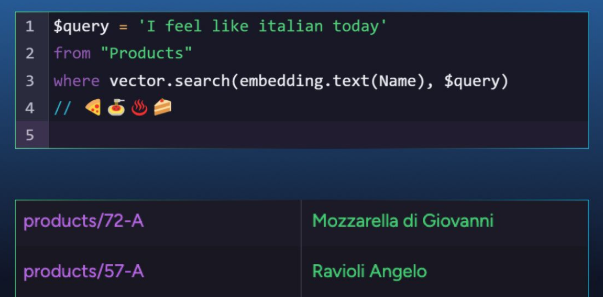
Embedding models take your data and translate it into a multidimensional mathematical space based on its meaning. Similar items will be located near one another in this multidimensional space, and we can take advantage of that using vector search. That is why you can find Mozzarella & Ravioli if you want Italian food today, as in this example:
The problem is that all embedding models have a context limit. There is only so much text that you can push into the model before it will give up on you. If you want to search through a much bigger piece of text using semantic search, you need a different approach.
The industry standard approach to handling this is via chunking. In other words, you take a long piece of text, split it into separate parts called chunks, and generate an embedding for each one separately.
The easiest way to think about this is that you have a long document, and you generate a separate embedding vector for each page of text independently. Instead of having to digest a whole article, you feed a bounded chunk (page) to the model to generate an embedding vector.
Chunking is a neat trick, but it leads to its own set of problems. Assuming we have a large document that talks about new features in RavenDB, with a particular page that expounds on the details of “the database’s ACID guarantees". What would the embedding vector for that page look like?
If we just chunk the data naively, we’ll get a vector that is related to the generic concept of ACID in databases. The chunking approach loses the context of the data; it doesn’t understand that the database in question is RavenDB.
Contextual embedding allows you to bake a global perspective directly into every chunk’s embedding. In other words, the embedding for that page would know that the database that is being talked about is RavenDB.
If you are dealing with large texts and want to have high-quality search, contextual embedding is a feature you want. I guess that explains why MongoDB paid 220 million dollars for Voyage AI.
Sadly, I left that sum of money in my other pants, so RavenDB’s strategy for dealing with this scenario is quite different. We planfor models to become a commodity, so there is little benefit in trying to produce your own models at this point in time.
Instead, RavenDB takes the approach of working with all off-the-shelf models. That means that we are far more flexible, using the latest state-of-the-art models, instead of having to keep chasing them. But only some models support contextual embedding…
Luckily, we figured out that we can add this feature from RavenDB’s side, without needing to develop a custom embedding model for this. The technical announcement about it is here, with all the details. But the gist of it is that RavenDB allows you to attach context to the value you send for embedding.
The scenario below shows an example of storing litigation files using RavenDB and enabling proper semantic search over large amounts of data:
You can see that we generate embeddings for quite a few fields. For all of them, we use a chunking strategy of 2K tokens with an overlap of 128 tokens. Note the last line that adds a withContextPrefix call, where we add the Headline as part of the context for the data we’ll be embedding.
This additional context gives the embedding model enough information to contextualize the information we give it. The nice thing about this feature in RavenDB is that we don’t need to have any special support from the model. Everything is handled directly by RavenDB. That includes chunking, caching, adding the context, etc.
What to do when I don’t have pre-existing context to add?
If you have a title for an article, or a summary already written for you, that is great. But what happens when no such thing exists? You can also use GenAI tasks in RavenDB to process the data and get a proper summary (and then generate the embedding with that summary to have better queries).
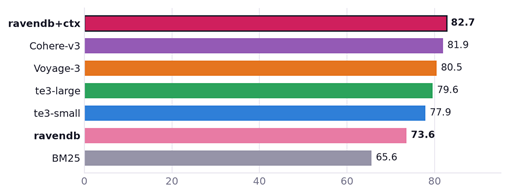
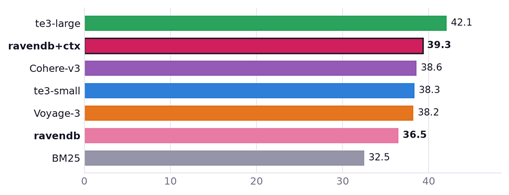
I took the context prefix feature for a spin with a bunch of well-known datasets in the field of embedding and retrieval. We are using nDCG@10 — normalized Discounted Cumulative Gain at rank 10, the standard retrieval-quality metric on the public BEIR, LoCoV1, and LongEmbed benchmarks.
The underlying embedding model we use is OpenAI’s text-embedding-3-small, and we use exact() vector search in RavenDB, since we are testing purely the embedding output.
Adding context to chunked documents
For the following benchmarks, we defined two embedding tasks. One that would simply generate chunked embeddings from the raw text (with 256 tokens per chunk), and another with additional context taken from the document’s title.
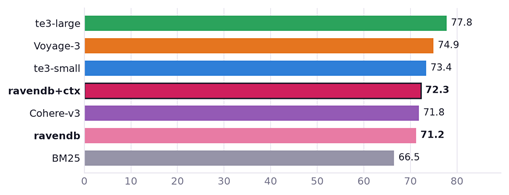
COVID-19 literature comprising ~129K near-identical CORD-19 papers with short, keyword-like queries. The abstracts all look alike, so the paper’s title is the single most discriminating signal. You can see that this approach is able to provide better results than any of the other options.
Fair benchmarks are hard (we made it harder for us)
In the following benchmarks, the ravendb and ravendb+ctx entries are the only ones that are actually using chunking. In other words, all the other alternatives are getting the full document to work on. And indeed, you can see that the ravendb entry (which does native chunking) isn’t doing that well in this benchmark. With the added context, it reaches the top.
Chunking at 256 tokens was used because it is a reasonable chunk size (about two paragraphs of text), and at that size, you may lose the context of the overall document. This allows us to showcase how effective the additional context technique is. That is also quite useful for additional focus. Embedding quality degrades with the length of the text, so shorter chunks embed their concepts much more faithfully.
Consumer-health and nutrition queries matched against PubMed documents. Titles name the medical topic (such as a condition or a nutrient), which disambiguates heavily overlapping biomedical text; the prefix lifts us past published text-embedding-3-small results. In fact, only text-embedding-3-large is able to do better than us here (see below for benchmark results showcasing RavenDB’s approach with text-embedding-3-large).
Scientific-claim verification against research-paper abstracts. The title names the paper’s specific finding, nudging near-duplicate abstracts apart, but the abstract is already on-topic. The gain is modest, and we land within a point of the published te3-small score.
As you can see, in this case ravendb+ctx is doing better than ravendb. However, I wouldn’t say that it is doing well. The chief problem is that chunking to such a small size really hurts us, and just using the full document is better.
Testing additional context with text-embedding-3-large
We intentionally test this approach with a modest model (text-embedding-3-small that has ~100M - 300M parameters). Does this approach scale when we use a bigger model? The text-embedding-3-large model is estimated to be in the 1B - 2B parameter range. How does it behave when we use the same technique?
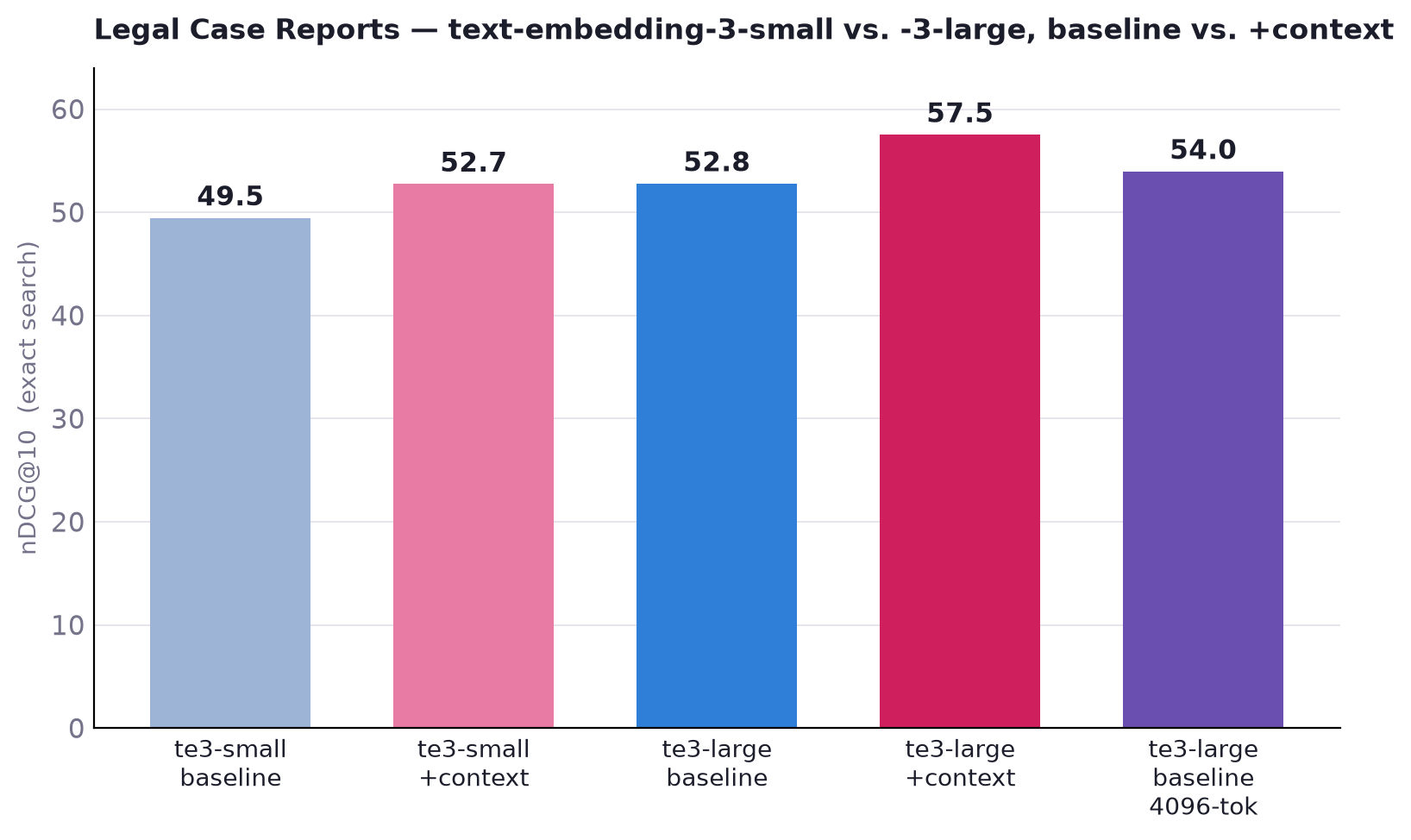
In the graph below, we are testing the Legal Case Reports dataset, which has a lot of large documents (some with > 100K tokens and many over the 8K token limit).
We tested the quality of the results with chunking of 256 and 4096 tokens.
You can see in the graph that text-embedding-3-large is indeed better than text-embedding-3-small. There is a +3.3 difference between the baseline numbers of both models.
With the context option, however, text-embedding-3-small is almost as good as text-embedding-3-large! And with context, text-embedding-3-large ismuch better.
We also tested text-embedding-3-large with a much larger chunk size of 4K, which should give it more context to draw on (but also dilutes that contextt). Even so, it wasn’t able to beat the additional context (with a much smaller chunk size).
Dealing with large documents
The previous datasets we dealt with all had documents that fit nicely within an embedding model context window. Now we are going to deal with much longer documents (5K–470K tokens each). To make things more interesting, these have no natural title to anchor a chunk.
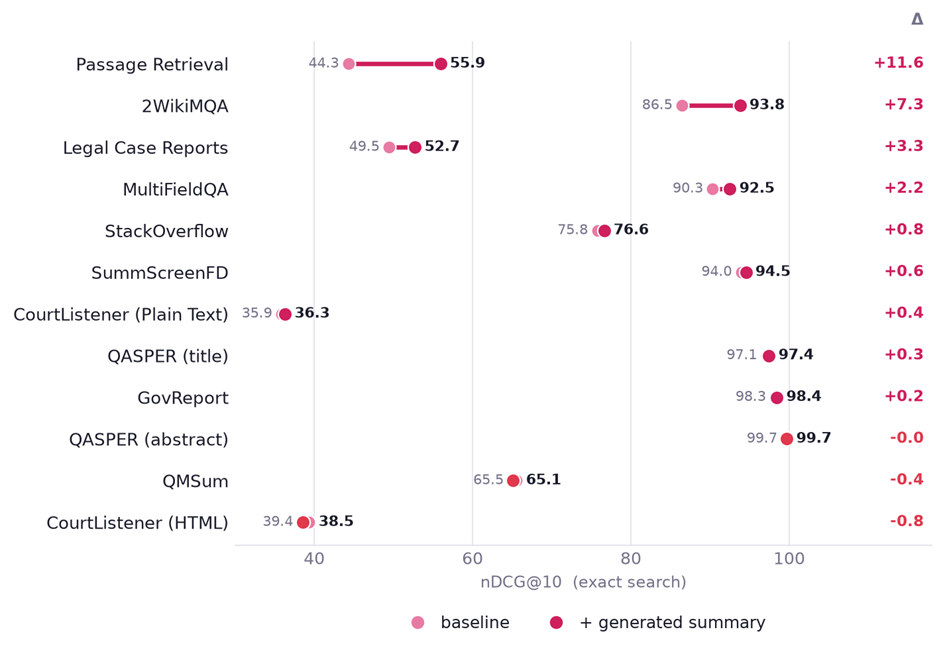
To handle this, we use another RavenDB AI feature, GenAI Tasks, which reads the first 16K of the document and generates a short summary for it. We then use that summary as the additional context for the chunking.
Without further ado, here are our results:
Those datasets were taken from the LoCoV1 and LongEmbed datasets. They are quite large and are usually used to explicitly test handling very large documents.
You can see that this technique shows a measurable impact on most (but not all) of the datasets we have tested. It gets more interesting when you compare it head to head with the actual results of the LoCoV1 and LongEmbed papers.
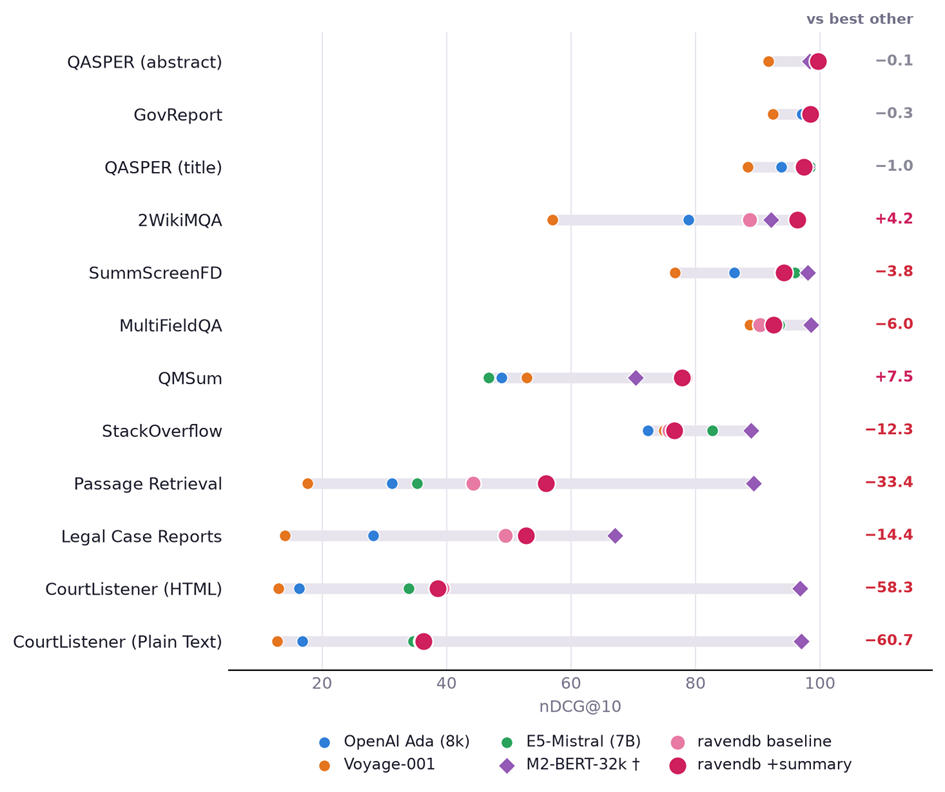
The results we are showing here show us being worse on almost every level, which would typically be a Bad Thing. In this case, we are comparing RavenDB using an off-the-shelf embedding model (with chunking!) versus dedicated top-tier embedding models that process the whole document.
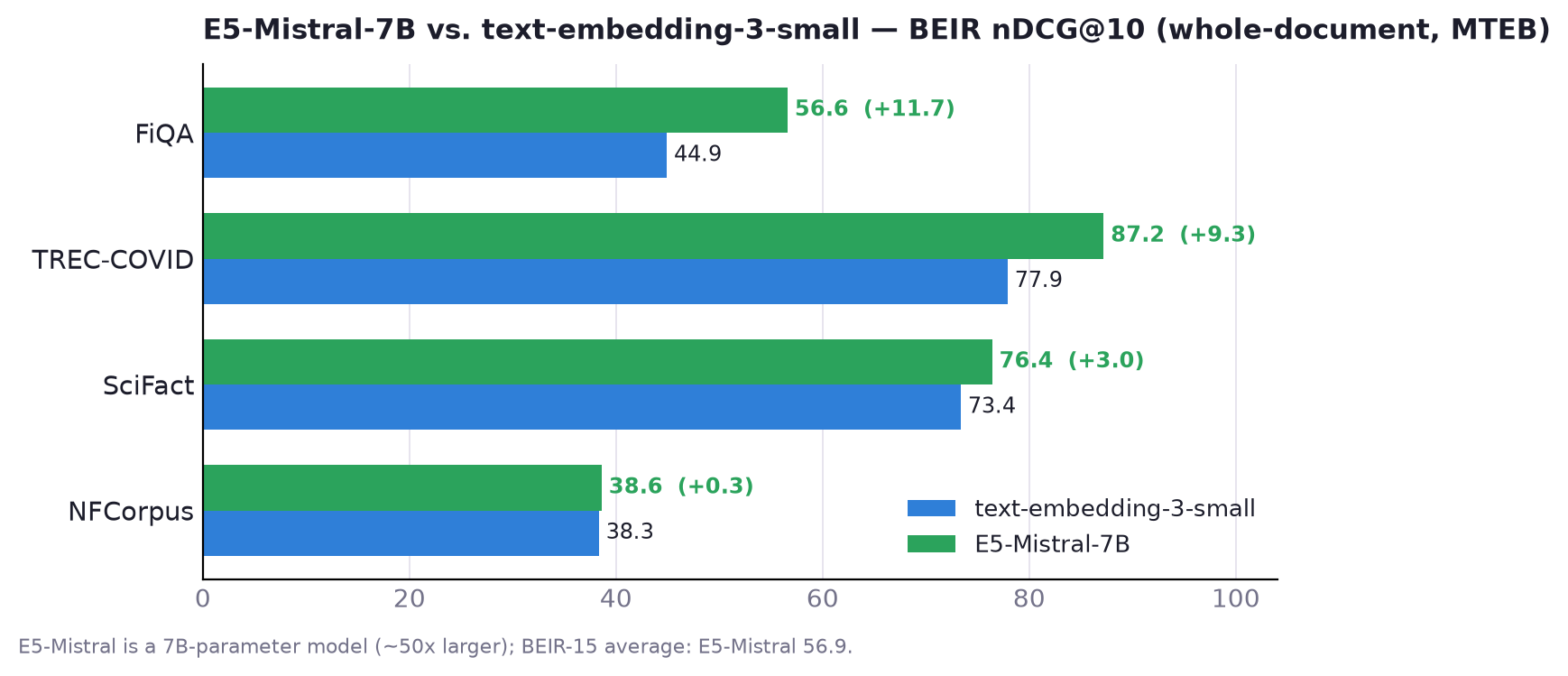
Across almost every task RavenDB is able to exceed the results of OpenAI Ada, Voyage-001, and E5-Mistral-7B. Let’s take E5-Mistral-7B as a good example. It is a 7B parameters, while text-embedding-3-small has only 100M - 300M parameters, making it about 50 times smaller.
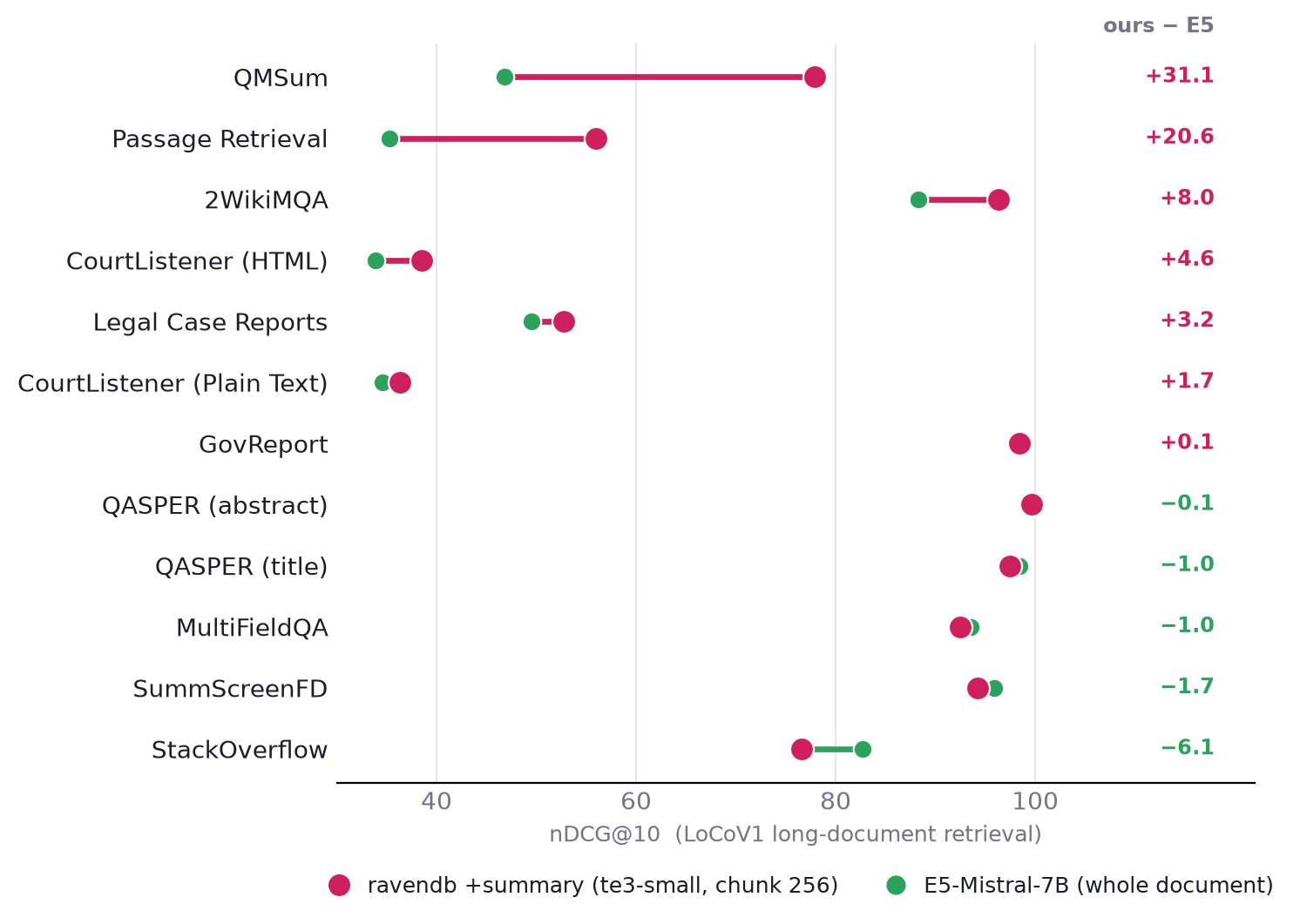
On the other hand, when we use the same text-embedding-3-small and our context prefix approach, we get the following results:
The most interesting thing about this graph is what this means. There is a very clear divide between the datasets where E5-Mistral-7B is leading and those where RavenDB’s approach leads (with a much smaller model).
The whole-document 7B model dilutes long text into one vector; our approach keeps focused chunks and restores document context via the summary. In the datasets composed of short documents, Mistral wins handily (it's a 7B model, ~50× bigger).
On long documents, RavenDB’s approach flips that by large margins when the answer is spread across the document (QMSum, passage retrieval, multi-hop QA). On long documents the chunk+context prefix strategy buys much more than raw model size does.
The 7B model reads the whole document into one vector and gets diluted; the small model retrieves a focused chunk and gets its document context back from the summary.
Summary
RavenDB’s context prefix feature shows how a different architecture can get you better results and higher efficiency. RavenDB’s approach allows us to go head to head with dedicated models and still come out ahead when dealing with large documents and complex tasks.
It also works on any model. I used text-embedding-3-small specifically because it is a baseline model, not a top-tier one. The fact that this is model-agnostic means that you can tune your approach based on your dataset and your requirements. When a new (and better) model comes by, you can just move to it and still reap the benefits.
This approach won’t cost you 220,000,000 USD. I just checked, and producing this blog post cost us about $110 (most of that by generating summaries for the large documents, to be honest). Only $22 of that was spent on the actual embedding.
Pair a DGX or Mac Studio in a cupboard with Gemma 4 (another great 7B embedding model) and RavenDB’s context prefix mode. You get top-tier results for a one-time ~$4,000 USD hardware investment, with no monthly bills.
About twenty years ago, I was working on what would eventually become RavenDB, and I needed an engine to handle queries. Writing a query engine from scratch is its own very large project, quite separate from writing a database engine. I made a decision that I still consider one of the smartest I made in those early days: I built on top of Lucene as my indexing and query engine.
That let me stand on a firm foundation while I dealt with the problems I actually cared about: building a NoSQL solution that didn't feel like juggling knives. Lucene gave me a mature, battle-tested way to index and query data, and I got to spend my time on the parts that made RavenDB RavenDB.
It was a good decision. But like a lot of good decisions, it came with a bill attached, and the bill arrived about a decade later.
Making use of features that are already there…
Here is a query that every developer has written a thousand times: give me the ten most recent posts on my blog. You write those sorts of queries in every kind of application you write, after all. And there is the natural follow-up: tell me the total number of posts, so I can render the pagination.
In most databases, you need to make two separate queries for this, and those two queries usually mean two separate database roundtrips. One to fetch the page, one to count the total.
In RavenDB, it's one query. You ask for the page, and you get the total count back in the same response.
This matters a lot more than you may initially think. In most systems, the cost of the network round-trip to the database dwarfs the cost of the query itself. The query runs in microseconds; the round-trip is the expensive part. So folding the count into the same response that carries the results eliminates an entire round-trip. When you run a paged query in RavenDB, you get the total number of matching results for free, and that is genuinely a wonderful feature.
The important word in that paragraph is free. I did not design this feature. I did not sit down and decide that paged queries should return a total count. Lucene already computed it, for reasons of its own, as a side effect of how it processes a query. I got it for nothing, exposed it through the API, and it became one of those small touches that made RavenDB pleasant to use and made your application run faster.
A free feature that adds real value, give me more of that!
Fifteen years later
Imagine a time skip of a decade and a half: we start building Corax, the next-generation query engine for RavenDB. Remember when I said that building a querying engine is a Big Project? I meant it.
It turns out that most databases do not give you the total result count for free for a very good reason: It isn't free. Consider the following queries and their internal representation in the database:
from Posts
where IsPublished =true
limit 10
from Posts
where IsPublished =trueand PublishedAt <=$today
limit 10
from Posts
where IsPublished =trueand PublishedAt <=$todayand Tags in($tags)
limit 10
It is easy enough to check the number of posts that are published. A range query on a date field is more complex, especially if you have a lot of posts. Getting the total number of posts in a set of tags is more complex, since a post can have multiple tags and you need to deduplicate.
The intersection of three clauses, of course, is distinct from the count of each.
The queries above can stop further processing once they have 10 results, after all. But when you need an exact count for the query, you need to actually evaluate it.
Lucene happens to produce it as a byproduct of its execution model, but in the general case, computing the total number of results for a query can be enormously expensive.
Imagine a physical phone book, and I ask you to get me the first ten people whose family name is Smith. You flip to the S section, find Smith, read off the first ten entries, and hand them back. Notice what you didn't do: you never counted how many Smiths there are.
Now I ask you for the total number of Smiths. Suddenly, you have to go through every single Smith in the book and tally them. Smith is a common name. The cost of counting all of them can be far higher than the cost of just grabbing the first ten.
If you want a count, you have to actually count, which means touching every matching result, even the ones you're about to throw away. For large queries, getting the count can be the most expensive part of the query.
The feature is still meaningful, to be clear. There are plenty of cases where you genuinely need the total so you can build proper pagination. And in those cases, going to the database twice and paying for two network round-trips is wildly wasteful, so bundling the count in is exactly the right thing to do.
How would I design this today?
I would approach this very differently. You often don’t need an exact count; you just need to show something so the application can render the paging controls and maybe show a rough count to the user.
I would probably expose an EstimatedCount property for the queries, which is cheap, as well as a way to ask for an exact count in a single roundtrip. The key is that we would be clear in the contract that this is an estimation only.
But because this was a basic, baked-in behavior of RavenDB, something we'd done "for free" from day one, Corax inherited an expectation that it had to provide an exact count. We were doing work on every query, only to end up discarding the result of that work, because the original engine had made it cost nothing, and so everyone assumed it cost nothing.
How we dealt with it
We solved this with a combination of approaches.
First, it turns out you don't always need the count. Since the count is requested through the API, we made it explicit: the client can say "I care about the total count" or "I don't care about the total count." When the client opts out, we get to skip all that work. That alone recovers a lot of wasted effort.
Second, queries in RavenDB request the count far more often than they do in other databases, precisely because it used to be free. Years of RavenDB code were written assuming the count was always there, so there was enormous pressure to make counting itself fast rather than just optional. We did a significant amount of work to optimize how counting happens.
And this turns out to be a genuinely deep area. There is a whole body of research on how to count query results with as little work as possible. People have earned PhDs on this problem. What looked, from the application developer's seat, like a single integer that just shows up in the response is an entire field of study once you're the one who has to produce it.
Hyrum's Law sends its regards
There's a principle called Hyrum's Law that captures exactly what happened here:
With a sufficient number of users of an API, it does not matter what you promise in the contract: all observable behaviors of your system will be depended on by somebody.
The actual lesson
When you get something for free from a dependency, you are not just accepting a feature. You are accepting an obligation. The behavior becomes observable, the observable becomes relied upon, and the relied-upon becomes a promise you have to keep, possibly long after the dependency that gave it to you is gone.
The real price of a dependency is the behavior that you need to carry forward down the line, because it became part of your contract and your users rely on it. And that requires very careful consideration.
I want to be careful here, because the lesson is not "don't take free things" or "don't depend on Lucene." Building on Lucene was the right call, and exposing the count was the right call. I'd probably make both decisions again (although I would weaken the promise about the accuracy of the count).
To be more accurate, I don’t think that the person who took that dependency twenty years ago was even able to properly understand the impact of that feature or its future complications. On the other hand, that specific feature was something that I frequently demoed, and it always got a great reaction. This touched a pain point that many people had.
I've written before about why I think the “modern” approach of solving every problem by adding agents is a doomed path. The current instinct is to add more layers of agents, judges, reviewers, etc. - and hope the model will be smart enough to do the right thing and actually get something done.
The issue is that we already have a well-understood way to coordinate independent contributors working on a complex system. It's called software design & architecture, and we've been refining it for decades. The instinct to solve a coordination problem by adding a smarter message bus between your agents is exactly backwards.
When talking about multi-agent support in RavenDB, I want to be clear about what we did not build. We didn't build an orchestration framework. We didn't build a swarm. What we built is much more boring, and I mean that as the highest compliment I know how to give.
We built a way for you to solve problems in a predictable manner and without a lot of hassle.
If you haven't looked at RavenDB's AI Agents yet, the short version is this: an agent is a system prompt, a connection to an LLM, and a set of Query tools, which let the agent read specific data through RQL you define, and Action tools, which let it do something in your application, but only through the specific doors you've opened.
The note on “specific” is the whole point. Instead of giving the model the freedom to access any data it wants and execute anything it feels like, we place careful guardrails that it cannot escape.
The agent can only pull the levers you gave it, using the data you explicitly handed it. The database takes care of the tedious, error-prone plumbing (such as conversation state, message history, talking to the model provider, etc.) and stores every conversation as a real document in the @conversations collection. You define capabilities, and RavenDB takes care of all the rest.
Where one agent starts to hurt
A single agent like this will take you a genuinely long way. Right up until it doesn't. The issue is the slow creep of complexity. Let’s say that you start with a simple agent to deal with answering employee questions in the context of the HR department.
The next feature is to assist them in filing expense reports. Then someone wants it to handle time-off requests, and then to look up the org chart, and six months later you have one prompt trying to be an entire company, with thirty tools competing for the model's attention and a context window stuffed with things that have nothing to do with the question being asked.
That situation is problematic on multiple levels:
Your context window is full of a huge prompt (usually not relevant to the task at hand), a lot of tool descriptions and capabilities meant to cover every possible scenario under the sun.
Users’ questions are either squeezed into the remaining context window or you have to move to models with larger context windows, which also cost more.
You are also stuck with a single model for everything, instead of being able to pick the right model for each scenario. You overpay to run trivial chit-chat on your best model, or you cripple the hard tasks by forcing them onto a cheap one.
This is not a new problem. Scope is how you manage complexity, and it works exactly the same whether the thing on the other end is a compiler or a language model.
Multi-agents are just agents that talk to each other
A multi-agent system in RavenDB is not a special kind of agent. It's several ordinary agents, each built exactly the way you already know how to build one, where one of them happens to know that another exists and can hand work to it.
The way you connect them is almost anticlimactic. You add a SubAgents entry to the parent agent: an identifier and a description. That's the entire wiring job. The description matters because that's what the parent reads to decide whether a given request belongs to the specialist. There is no router you write, no dispatch table, no orchestration layer.
You made the subagent available to the root, and RavenDB will invoke it for you when it is needed. RavenDB will also handle all the logistical minutiae needed to accomplish this successfully.
Those include ensuring that the scope for the root agent is shared with the called subagents, managing memory and conversation history, allowing the subagent to invoke its own queries and actions, etc.
We ship a demo for this — an HR chatbot, samples-hr on GitHub if you want to run it yourself. An employee comes back from a conference, uploads the receipt, and types "submit this expense." From their side, it's one smooth conversation.
Behind the scenes, it's two agents. The HR Assistant faces the user and handles benefits, policies, and general questions. It does not know the first thing about filing an expense. What it does know is that there's an Expense Manager specialist, and — from that one-line description — that receipts belong to it. It hands the task over, the specialist analyzes the receipt and creates the BusinessTripBills document, and the answer flows back up.
Go look in the database afterward and you'll find two conversation documents, not one — the HR Manager's log and the Expense Manager's log, each with its own scoped history. That's not an implementation detail I'm mentioning for trivia's sake. It means you can open either conversation and see exactly what that agent received and how it responded. The audit trail falls out of the design for free.
Here's the parent agent, trimmed down to the part that matters:
public staticTaskCreate(IDocumentStore store){returnstore.AI.CreateAgentAsync(newAiAgentConfiguration{Name="HR Assistant",Identifier=AgentIdentifier,ConnectionStringName=ConnectionStringName,SystemPrompt= @"You are an HR assistant.
Provide info on benefits, policies, and departments.
Do not suggest actions that are not explicitly allowed by the tools available to you.
Do NOT discuss non-HR topics. Answer only for the current employee.",Parameters=[newAiAgentParameter(EmployeeIdParameter,"Employee ID; answer only for this employee")],// The HR agent has no idea how to file an expense.// It just knows a specialist exists, and when to call it.SubAgents=[newAiAgentToolSubAgent{Identifier=ExpenseAgentIdentifier,Description="Manages business trip expenses: analyzing "+"receipts/bills, reporting expenses, and retrieving "+"monthly expense summaries."}],// Its own capabilities cover only HR concerns.Queries=[newAiAgentToolQuery{Name="GetEmployeeInfo",Description="Retrieve employee details",Query= $"from Employees where id() = ${EmployeeIdParameter}",ParametersSampleObject="{}"}]});}
The Expense Manager, for its part, is defined in exactly the same way as any other agent. There is nothing special about it. It's a normal agent that happens to be pointed at by a SubAgents entry.
Notice what this buys you. The HR agent never sees the finance tooling. It doesn't integrate the expense system, doesn't swallow that domain, or deal with a BusinessTripBills document. It shells the call out to the specialist and stays in its lane. If tomorrow finance wants their own policy-checking agent in the loop, you add another SubAgents entry to the Expense Manager and the HR agent is none the wiser. Each piece keeps a small & independent scope.
Each of those agents is isolated from the others, so we can have the HR Agent use a pure textual model, maybe with high levels of reasoning. The Expense Manager agent, on the other hand, needs to be multimodal (to be able to read receipt images), but it doesn’t need to be smart. You can customize each for its own needs, without having to find the lowest common denominator.
The fact that each of those agents (even if they both participate in the same conversation) will use separate @conversations documents also means their contexts are isolated from one another. The fact that you just pushed the entire set of receipts from a two-week business trip to the Expense Manager agent doesn’t weigh down the HR agent when you ask about your remaining holiday balance.
When you should not do this
This shouldn’t be your default architecture. Like any advanced technique, you need a sufficient level of complexity to justify it. If the work fits in one sentence, it probably fits in one agent.
Answering from a knowledge base, generating a document from a template, running a linear sequence with no branching — a single well-built agent handles all of that, and reaching for sub-agents just to keep things tidy or to mirror your org chart is perfectionism. It's the same mistake as premature abstraction, and it costs you real latency and real tokens for the privilege.
Multi-agents earn their keep when one of the following is true:
You need to independently develop the agents (different teams are handling different agents).
You will use different models for different parts of the system.
You want to explicitly limit the sharing of context between different parts of the system.
For example, keeping with the HR agent theme, let’s say that we want to allow users to ask questions about our policies (an example of such an agent). The problem here is that we may have a lot of policies, and even when we limit ourselves to the right one, that is a lot of text.
Shoving all of the work of finding the right policy and extracting the specific elements to match the user’s question into an isolated agent can massively reduce the number of tokens that your agents will burn.
Summary
RavenDB’s multi-agents aren’t about orchestrating a robot army or an independent swarm of self-coordinating agents. It is far more prosaic than that. You're composing independent components with clear boundaries and letting each one own a scoped conversation, its own tools, and the model that fits its job.
That's not a new idea we invented for the age of AI. It’s bringing back the notion of independent components that are greater than the sum of their parts, in a way that is manageable, consistent, and hassle-free.
Everyone talking about coding models fixates on the same number: how fast the thing generates code. This misses the point by a lot. The story isn't about how fast the model writes code I would have written anyway.
It's that the model lets me do things that I might have done before but were expensive enough that I didn’t bother. I had three separate interactions this week that led to this blog post.
We had a production problem on an instance and no clear idea what was going on. What we did have was the log: something like 25-30 MB of compressed text describing everything that happened. And the actual problem wasn't spotting an error: finding errors is easy. The problem was correlation. We needed to line up different events across the timeline and understand how they were related.
In the past, I would have to trawl through the log and hope that something would pop up. These days, we can try handing the whole thing to the model and let it figure it out. If the log file wasn’t that big, it might even work. At dozens of MB, it doesn’t work (and it is quite expensive to try).
I went the other way. I told the model: “Write me a script that looks at the structure of this log (I gave it the first ten rows). I want the script to extract and aggregate the parts I care about, and render the result in a nice table to make it easier to understand.”
I had the view in under a minute, then I could explore the log and iterate:
“Oh, I see that there are a lot of indexes. How many of them are for the same database?”
“Give me a histogram of index changes and their versions over time.”
The model wrote some code, produced a view, and I looked at it. Rinse & repeat until I had a pretty good idea what was going on.
The customer had several different versions of their application, each with its own set of indexes, and they kept overwriting one another, leading to a huge amount of indexing overhead. RavenDB actually has a dedicated feature for that scenario.
Here's the part that matters: I never read the code the model wrote. The moment the investigation was done, I threw all of it away. It's throwaway code whose entire purpose was to help me see, and once I had seen enough, I discarded it.
Without the model to write this code, I could have written it myself, but it is enough of a chore that it probably wouldn’t make sense. Doing that manually would have taken roughly the same amount of time.
The second interaction is the opposite kind of work. I'm doing a fairly significant refactor of how a particular query executes in Corax, and that code is going into the product and staying there for a decade or two.
Here, the model writes and I drive. I tell it the overall direction, it goes somewhere, and then I decide if I like the result. I find it genuinely easier to react to something than to produce it from a blank page — having a first draft to push against is faster than writing it all myself. Nevertheless, this is my code. I went over every single line, and I know exactly what's in there.
That last part takes real discipline, and it's worth being honest about why. When you're in the zone chasing a change (try something out, revert, try something else, etc.), it is very easy to surface a few hours later staring at two thousand lines of changes you never actually wrote. You went through a dozen iterations, and somewhere in there the code stopped being something you authored and became something that merely happened. Guarding against that is really important, because otherwise that isn’t your code.
How do I make sure it's still mine? I lean on tests, of course — regression tests to prove I didn't break the old behavior, and new tests built alongside the change to pin down the new behavior. That's the baseline for anything long-lived.
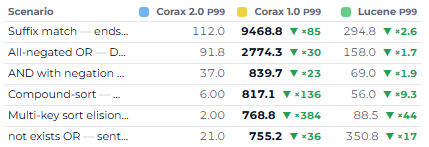
The technique I found most useful for confirming that the change is really mine is a little unusual. I had it build a harness that runs a set of scenarios against both the old version and the new one. It's a small app that issues queries and operations to the database and visualizes the results.
Here is what this looked like:
You can see that I have a bunch of scenarios that I’m testing, and it is very easy for me to track progress and know where I need to pay attention. The actual app had a lot more capabilities: what got faster, what got slower, the ranges, the memory used, everything and the kitchen sink went into that, in a format that made sense for the sort of work I was doing.
Each time I had a new direction, it was either driven by this application or I asked the model to add it to the application, so I could keep working on it. I kept working until nothing in the new version was slower than the old, and the headline paths were dramatically faster.
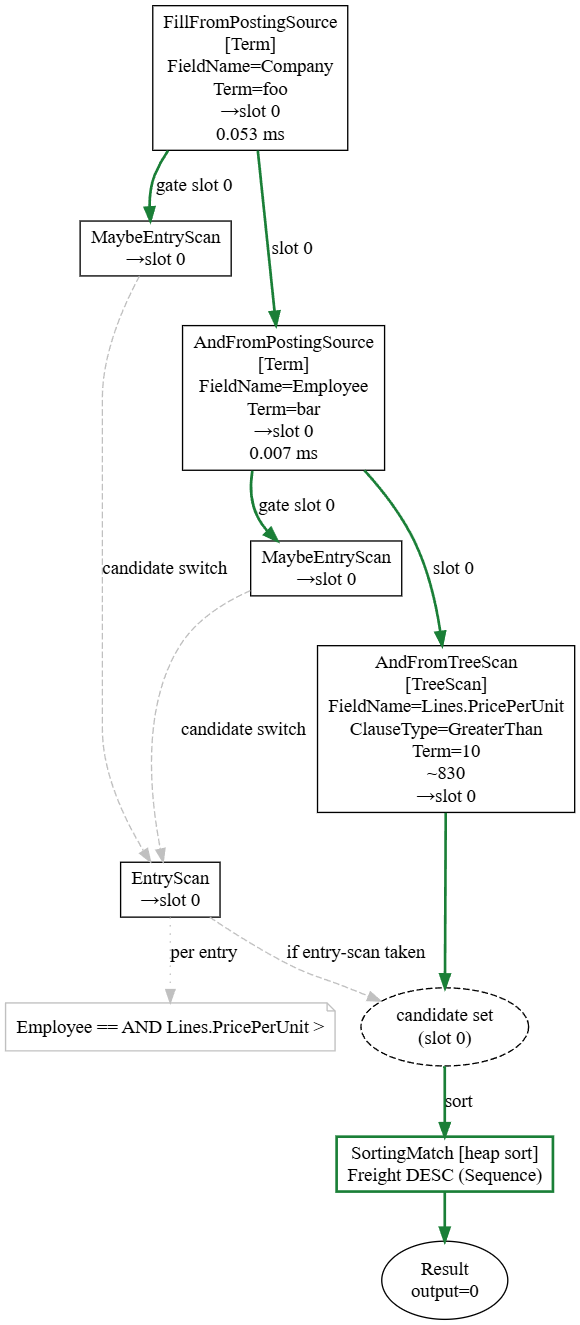
As an example of what this looked like most of the time, I ran a query, and then I inspected the structure we got back. Here is what some of that looked like:
And as I went, I kept changing the harness itself — show me this instead, group it that way. Trivial to do, because the harness is also throwaway. I'm not carrying it forward. I don't care about its code quality. I never even looked at its code. It exists to make a point, and once it's made the point, it's gone.
I also used the model to add introspection hooks and visibility into what was going on inside the system, surfacing stuff that you would usually have to scratch your head and debug to understand. That meant that I was able to look at a problematic query, then just look at its query plan and the timing in it. I usually knew where I needed to pay attention from there.
To be honest, that part feels a lot like cheating.
In the cases of the log analyzer and the comparison harness, the code is literally disposable. It’s scaffolding that would be thrown away after the work is done. I didn’t pay any attention to that code (I never read it), and it was never meant to be useful for anything else.
In the case of the production code, I went over each line of code so many times, I dreamt of it. A lot of the code there consists of annoying building blocks (building a visualization of the query plan as a graph, for example), which were sped up enormously by asking the model to build it for us. A lot of other code there is hand-crafted to say exactly what I needed it to.
But the fact that I can get good scaffolding from the model for cheap changes a lot of the usual considerations. Because scaffolding is literally disposable code, I don’t have to worry about the usual code quality concerns. The log analyzer would probably take two or three hours to write (without the pretty graphics, which were helpful for easily identifying what was going on).
The comparison harness would be multiple weeks of effort and would probably be a non-interactive ASCII table. In fact, I don’t need to guess. Scaffolding isn’t something that is new, I do that all the time. Here is an example of one, written about a decade ago:
In the image above, you can find the internal structure of a B+Tree inside RavenDB. Contrast that with the following scaffolding for query plans. That one, by the way, is actually staying in the product.
Compare that to the level of insight that you can derive from the query plan higher up in this post. The B+Tree scaffolding, by the way, is essential to understanding the more complex scenarios. It paid for the time it took to write it many times over.
The ability to now effectively do the same at very little cost means that the act of building software itself is now easier. Not because someone else is writing the core code, but because everything else that we need to do is also easier.
I am looking into some regex work, and I ran into a performance problem. I need to run a particular regex over a large number (millions) of strings. That caused my spidey sense to… tingle.
The code in question looked something like this:
long matches =CountMatchingEntries(newRegex(@"\s+user id\s+"));
Creating a regex for each invocation is… expensive. That is why we have the RegexOptions.Compiledflag, after all. And the Regex class is thread-safe, so I did the equivalent of this code:
// class levelstaticRegex s_regex =newRegex(@"\s+user id\s+", RegexOptions.Compiled);// inside a methodlong matches =CountMatchingEntries(s_regex);
The performance of the system immediately took a big, stinking performance regression all over my benchmarks. At first, I was sure that I wasn’t doing something properly, so I re-wrote this using the modern approach, with source generators, like this:
That had the exact same behavior, a major performance regression.
We are talking about this making the code six times slower. That is a huge cost for something that every fiber in my being tells me should be faster. As I started digging into things, I managed to reproduce this in an isolated manner.
The following benchmark shows the core of the problem:
usingSystem.Diagnostics;usingSystem.Text.RegularExpressions;var lines = Enumerable.Range(0,100_000).Select(i =>$"The user id #{i}").ToArray();var regex =newRegex(@"\s+user id\s+", RegexOptions.Compiled | RegexOptions.CultureInvariant | RegexOptions.IgnoreCase);// This is fastExec(()=> lines.Count(l => regex.IsMatch(l)));// This is slowExec(()=> lines.AsParallel().Count(l => regex.IsMatch(l)));staticvoidExec(Func<int> run){var before = GC.GetTotalAllocatedBytes();var sw = Stopwatch.StartNew();//var count = lines.AsParallel().Count(l => MyClass.UserIdRegex().IsMatch(l));var count =run();
sw.Stop();var after = GC.GetTotalAllocatedBytes();
Console.WriteLine($"Count: {count}, Time: {sw.ElapsedMilliseconds} ms, Memory: {after - before} bytes");}
I create the sameRegex instance and run it 100,000 times. The first time, I do that using a single thread, and the second time I’m using multiple threads.
The only difference between those runs is the addition of AsParallel() to force it to use multiple threads. My code isn’t actually using this or explicit threads, but it is using a single cached Regex instance in a web environment, so under load, it is being used concurrently.
What is going on here? The parallel code is much slower because it allocates. It turns out that deep in the guts of .NET’s Regex engine we have this block of code:
RegexRunner runner = Interlocked.Exchange(ref _runner,null)??CreateRunner();try{// do work}finally{
_runner = runner;}
In other words, the actual RegexRunner needs to keep some mutable state, which doesn’t play nicely with threads. In order to maintain itself under concurrent usage, the Regex “checks out” the instance when it is being used, so it can be the sole owner.
Other callers on the same instance at the same time will allocate a new runner instance. That is what is causing the massive slowdown. If we are using the Regex instance in a single-threaded manner, the code will check it in & out as needed, with zero allocations and quite fast.
If you are using that from concurrent code, you’ll allocate like crazy and can expect your performance to drop by as much as five times.
I created an issue for that, since I believe this is quite a tripping hazard in terms of performance.
The current fix that I found was to use ThreadLocal<Regex> for this, ensuring that there is no actual concurrent usage, at the cost of higher memory usage and repeated initializations.
Deep in the heart of Corax (RavenDB’s querying engine), everything deals with something called a Posting List. Posting Lists are a way for the engine to say “all of those documents have the term Fast for the field Speed”. Conceptually, a Posting List is an ordered set of document ids. In this case (and this is important, the ids in question are numeric, not RavenDB’s document id, which is a string).
An interesting problem with Posting Lists is that a term can be unique (such as a GUID) - only a single document will ever have this value. They can have a small set of values (for example, CreationDate, where only the items created on that day will share the same value). Or they can have many values (for example, Status = ‘Shipped’ for Orders).
The reason those details matter is that we can deal with the three (very) different modes in a distinct manner to reduce the cost of storage that Corax uses for Posting Lists. Internally, Corax has the notion of a PostingListId, which is just a 64-bit number. We use the least significant 2 bits to tell us what kind of Posting List this is.
Typical code to consume this looks like this:
while((read =provider.FillPostingListIds(plIds))>0){for(int i =0; i < read; i++){var postingListId = plIds[i];var termType =(TermIdMask)postingListId &TermIdMask.EnsureIsSingleMask;switch(termType){caseTermIdMask.Single:{// Accumulate the single decoded entry ID into the entryBuffer// Flush to bitmap if the buffer is fullbreak;}caseTermIdMask.SmallPostingList:{// Decode inline via FastPForBufferedReader into the entryBuffer// Flush to bitmap if the buffer is fullbreak;}caseTermIdMask.PostingList:{// Flush any accumulated entries from the buffer first// Iterate through the full large posting list via FillFromPostingsbreak;}default:thrownewInvalidOperationException($"Unknown TermIdMask type: {termType}");}}}
The code here iterates through a list of Posting List ids, handling each one of the options. This is part of handling queries such as: where CreatedAt > $lastQuarter. We have to get all the distinct dates in the range, and for each date, we need to get all the matching documents for it.
The code here is pretty simple, right? It is fairly obvious what it does, but it has a pretty big problem. It processes each one of the Posting Lists manually & separately. There are two problems with this approach:
We end up doing a lot of branching, based on which Posting List type we are processing.
We lose the ability to handle the Posting Lists in bulk.
Because we use the lowest two bits to store the type of the Posting List, we can do better. The insight behind the new approach is that (id & EnsureIsSingleMask) naturally yields 0, 1, or 2 — a perfect index into an array of buckets. Instead of a switch statement, we partition the batch in one pass with no per-item branches:
var buckets = new List<long>[3];while((read = provider.FillPostingListIds(plIds))>0){for(int i =0; i <read; i++){
buckets[(int)(plIds[i]& 0b11)].AddUnsafe(pid);}}
Of course, you’ll note that we aren’t actually processing those, just putting them in buckets. The fact that we are able to split them into groups in a branchless manner is a fun optimization task, but it doesn’t matter as much as the next stage… we can now deal with a list of Posting Lists that are already divided by type.
For example, for the list holding only a single unique value, I can run the following:
var singlesSpan =CollectionMarshal.AsSpan(buckets[0]);EntryIdEncodings.DecodeAndDiscardFrequency(singlesSpan,singlesSpan.Length);var singlesLen =Sorting.SortAndRemoveDuplicates(singlesSpan);bitmap.AddRange(singlesSpan[..singlesLen]);
This is great, because now I can process the entire list using SIMD in a highly efficient manner. But things get better when we look at the other lists. In the case of the small Posting Lists, for example, the ids that I’m reading are not the actual values, but point to where the values actually reside.
This gives me the chance to actually load them from disk in an optimal, batched manner, like so:
var smallsSpan = buckets[1].ToSpan();EntryIdEncodings.DecodeAndDiscardFrequency(smallsSpan,smallsSpan.Length);var smallLen =Sorting.SortAndRemoveDuplicates(smallsSpan);Container.GetAll(llt, smallsSpan[..smallLen],containerItems.ToSpan(),long.MinValue, pageLocator);for(int i =0; i < smallLen; i++){var item = containerItems[i];// read the small posting list and deal with it}
The key here is the Container.GetAll() call, which takes the list of unique Postings List locations and loads them in an optimized manner. In the previous code style, that was actually pretty hard to do. In this manner, it falls naturally from the way we write the code.
There are also advantages to the fact that we run tight loops with the same code, instead of branching for each type. We also ended up with less code overall, which is also nice.
I still remember the bookstore. I was holding a 600-page brick of a book on how to build Windows applications, trying to convince my mother that I really needed it. This was 1994 or 1995. A book was how you learned to program at that time. You took it home, you read it cover to cover, you typed the examples by hand, and somewhere along the way, the ideas sank in.
From there, the tools for learning kept evolving. Printed books gave way to CD-ROMs and then to online documentation. Then came the explosion of blogs and RSS feeds. I started this blog at that time, and I still consider that era to be one of the best ones in terms of having amazing access to smart and knowledgeable people, freely sharing their insights and experiences.
Google killed Google Reader (yes, I am still angry about that) and a lot of the new people learned via Stack Overflow. The world entered a strange equilibrium that lasted, honestly, more than a decade. If you learned to code any time between roughly 2010 and 2022, you probably learned through some combination of Google, Stack Overflow, and maybe YouTube.
Then the floor moved again. First it was ChatGPT, where you copy-pasted code back and forth. Then the models were integrated into the IDE. Now, with Claude Code and Codex, it is something else entirely: an agent that just runs, makes decisions, and does the thing.
The arc is striking when you lay it out. You used to have to go to a physical library, pick up a physical book, read it, digest it, and think about it. Today, the prevailing message to a new developer is essentially: you do not need to know any of that. Just describe what you want, and it happens.
Hidden costs for reduced conceptual depth
This shift is not just about convenience. It changes the depth of knowledge a developer carries, and that has consequences. Here is the example I keep coming back to. Imagine you ask a developer to show you a website that they built.
If you asked that in the late nineties, it meant something. To do that, you had to purchase a domain. Understand DNS well enough to wire it up correctly. Set up a web server, which meant getting Apache to actually run. Successfully configure PHP and deploy scripts to production.
By the time you could point to a working URL, you had to touch every layer of the stack. There was no other choice. Therefore, you were at least passingly familiar with a lot more than you would be today.
Ask that same question of many developers today, and the answer is a Vercel subdomain. That is not a dig at Vercel, mind you - it is a great product, and abstraction is the whole point. But some of these developers genuinely do not know what DNS is. They do not know what is running on the server versus the client. They do not know that there is even a meaningful distinction. And we have seen real security incidents come out of exactly that gap — secrets leaking into client bundles, auth logic running where it should not, and CORS misconfigurations that nobody understood well enough to notice.
Now extend that same dynamic one more step. Take the cohort of developers who will learn to program primarily through this new generation of agentic tools. The abstraction is no longer just over DNS or deployment. It is over the act of writing the code itself.
What is the role of a junior developer now?
I think we are going to end up with a genuinely different type of engineer and, as a result, a genuinely different type of system.
“If men learn this, it will implant forgetfulness in their souls; they will cease to exercise memory because they rely on that which is written, calling things to remembrance no longer from within themselves, but by means of external marks”.
Plato, Phaedrus (c. 429-347 BCE)
Every generation has been accused of being softer than the previous generation, as the quote above can testify. In this case, Plato is decrying writing as a corrupting influence on youth who no longer bother to just remember things.
Without the attribution, I don’t think you would have realized that this isn’t me talking about developers utilizing coding agents instead of learning on their own.
In software, we see much the same pattern. The person who wrote assembly looked down on the C programmer. The C programmer looked down on the Java programmer. The Java programmer looked down on the person gluing libraries together in Python. Each step up the abstraction ladder lets people build bigger, more ambitious things with less effort. That is mostly good.
But there is a real asymmetry this time. The earlier steps abstracted away mechanical work — memory management, boilerplate, deployment plumbing. This step abstracts away the reasoning itself. And reasoning is what you need when the abstraction leaks, which it always eventually does.
The question I am actually struggling with, day to day, is much more practical: how do I evaluate a junior developer in this sort of world?
The classic move was a take-home task. Build a small feature. Show me your thinking. The problem is that a capable model will produce a perfectly clean solution to any reasonable take-home in a few minutes. What you see in the submission tells you almost nothing about what the candidate actually understands. It tells you they can prompt well, which is a real skill, but it is not the skill I am trying to measure.
I can also ask them to solve a task while they are in our offices, so I can verify no AI use. But that is also stupid; I want them to use AI. After all, that is a great productivity enhancer. So I need a way to test understanding, not just the output.
The signals I care about are the ones that are hardest to fake in an agent-assisted world. Can you debug something when the model is wrong? Can you explain why a piece of generated code is subtly unsafe, or slow, or wrong in a way that only matters at the hundredth user? Can you make a reasoned call about which abstraction to reach for and which one to reject? When the system behaves unexpectedly, do you know where to look?
At the same time, those aren’t usually qualities that you can look for in a junior developer. Having those qualities usually means that they aren’t junior anymore.
People used to train on LeetCode tests as a way to show how good they were in interviews. That was a good stand-in to see what they knew and understood. What is the next stage here?
What does a junior do to exercise their skills and show that they can bring value to the team? I don’t know if I have good answers to those questions. But that is something we, as an industry, need to consider carefully.
I do not want to be the old man yelling at the cloud. The tools are genuinely great, and refusing to use them is its own kind of malpractice. AI coding agents can make you meaningfully more productive.
But when I talk to developers just starting out, the thing I keep pushing is this: use the tools, and also, on a regular basis, go down a layer. Set up a server yourself. Deploy something without a platform holding your hand. Read the DNS records. Look at what your framework is actually generating. Write something in a language without a package manager that hides the sharp edges.
Not because you will do it that way at work. But because the next time something breaks in a way the agent cannot fix you will have a mental model to fall back on. You will know where the seams are. You will know what to look at.
That mental model is, I suspect, going to be the thing that separates the engineers who compound over a career from the ones who get stuck the first time the abstraction leaks.




 +972 52-548-6969