

Oren Eini

CEO of RavenDB

a NoSQL Open Source Document Database

Get in touch with me:

oren@ravendb.net +972 52-548-6969

Posts: 7,645
|
Comments: 51,254
Privacy Policy · Terms
filter by tags archive
time to read 11 min | 2036 words

I've written before about why I think the “modern” approach of solving every problem by adding agents is a doomed path. The current instinct is to add more layers of agents, judges, reviewers, etc. - and hope the model will be smart enough to do the right thing and actually get something done.

The issue is that we already have a well-understood way to coordinate independent contributors working on a complex system. It's called software design & architecture, and we've been refining it for decades. The instinct to solve a coordination problem by adding a smarter message bus between your agents is exactly backwards.

When talking about multi-agent support in RavenDB, I want to be clear about what we did not build. We didn't build an orchestration framework. We didn't build a swarm. What we built is much more boring, and I mean that as the highest compliment I know how to give.

We built a way for you to solve problems in a predictable manner and without a lot of hassle.

If you haven't looked at RavenDB's AI Agents yet, the short version is this: an agent is a system prompt, a connection to an LLM, and a set of Query tools, which let the agent read specific data through RQL you define, and Action tools, which let it do something in your application, but only through the specific doors you've opened.

The note on “specific” is the whole point. Instead of giving the model the freedom to access any data it wants and execute anything it feels like, we place careful guardrails that it cannot escape.

The agent can only pull the levers you gave it, using the data you explicitly handed it. The database takes care of the tedious, error-prone plumbing (such as conversation state, message history, talking to the model provider, etc.) and stores every conversation as a real document in the @conversations collection. You define capabilities, and RavenDB takes care of all the rest.

Where one agent starts to hurt

A single agent like this will take you a genuinely long way. Right up until it doesn't. The issue is the slow creep of complexity. Let’s say that you start with a simple agent to deal with answering employee questions in the context of the HR department.

The next feature is to assist them in filing expense reports. Then someone wants it to handle time-off requests, and then to look up the org chart, and six months later you have one prompt trying to be an entire company, with thirty tools competing for the model's attention and a context window stuffed with things that have nothing to do with the question being asked.

That situation is problematic on multiple levels:

  • Your context window is full of a huge prompt (usually not relevant to the task at hand), a lot of tool descriptions and capabilities meant to cover every possible scenario under the sun.
  • Users’ questions are either squeezed into the remaining context window or you have to move to models with larger context windows, which also cost more.
  • You are also stuck with a single model for everything, instead of being able to pick the right model for each scenario. You overpay to run trivial chit-chat on your best model, or you cripple the hard tasks by forcing them onto a cheap one.

This is not a new problem. Scope is how you manage complexity, and it works exactly the same whether the thing on the other end is a compiler or a language model.

Multi-agents are just agents that talk to each other

A multi-agent system in RavenDB is not a special kind of agent. It's several ordinary agents, each built exactly the way you already know how to build one, where one of them happens to know that another exists and can hand work to it.

The way you connect them is almost anticlimactic. You add a SubAgents entry to the parent agent: an identifier and a description. That's the entire wiring job. The description matters because that's what the parent reads to decide whether a given request belongs to the specialist. There is no router you write, no dispatch table, no orchestration layer.

You made the subagent available to the root, and RavenDB will invoke it for you when it is needed. RavenDB will also handle all the logistical minutiae needed to accomplish this successfully.

Those include ensuring that the scope for the root agent is shared with the called subagents, managing memory and conversation history, allowing the subagent to invoke its own queries and actions, etc.

We ship a demo for this — an HR chatbot, samples-hr on GitHub if you want to run it yourself. An employee comes back from a conference, uploads the receipt, and types "submit this expense." From their side, it's one smooth conversation.

Behind the scenes, it's two agents. The HR Assistant faces the user and handles benefits, policies, and general questions. It does not know the first thing about filing an expense. What it does know is that there's an Expense Manager specialist, and — from that one-line description — that receipts belong to it. It hands the task over, the specialist analyzes the receipt and creates the BusinessTripBills document, and the answer flows back up.

Go look in the database afterward and you'll find two conversation documents, not one — the HR Manager's log and the Expense Manager's log, each with its own scoped history. That's not an implementation detail I'm mentioning for trivia's sake. It means you can open either conversation and see exactly what that agent received and how it responded. The audit trail falls out of the design for free.

Here's the parent agent, trimmed down to the part that matters:


public static Task Create(IDocumentStore store)
{
 return store.AI.CreateAgentAsync(
  new AiAgentConfiguration
  {
   Name = "HR Assistant",
   Identifier = AgentIdentifier,
   ConnectionStringName = ConnectionStringName,
   SystemPrompt = @"You are an HR assistant.
Provide info on benefits, policies, and departments.
Do not suggest actions that are not explicitly allowed by the tools available to you.
Do NOT discuss non-HR topics. Answer only for the current employee.",


   Parameters =
   [
    new AiAgentParameter(EmployeeIdParameter,
     "Employee ID; answer only for this employee")
   ],


   // The HR agent has no idea how to file an expense.
   // It just knows a specialist exists, and when to call it.
   SubAgents =
   [
    new AiAgentToolSubAgent
    {
     Identifier = ExpenseAgentIdentifier,
     Description = "Manages business trip expenses: analyzing " +
      "receipts/bills, reporting expenses, and retrieving " +
      "monthly expense summaries."
    }
   ],


   // Its own capabilities cover only HR concerns.
   Queries =
   [
    new AiAgentToolQuery
    {
     Name = "GetEmployeeInfo",
     Description = "Retrieve employee details",
     Query = $"from Employees where id() = ${EmployeeIdParameter}",
     ParametersSampleObject = "{}"
    }
   ]
  });
}

The Expense Manager, for its part, is defined in exactly the same way as any other agent. There is nothing special about it. It's a normal agent that happens to be pointed at by a SubAgents entry.

Notice what this buys you. The HR agent never sees the finance tooling. It doesn't integrate the expense system, doesn't swallow that domain, or deal with a BusinessTripBills document. It shells the call out to the specialist and stays in its lane. If tomorrow finance wants their own policy-checking agent in the loop, you add another SubAgents entry to the Expense Manager and the HR agent is none the wiser. Each piece keeps a small & independent scope.

Each of those agents is isolated from the others, so we can have the HR Agent use a pure textual model, maybe with high levels of reasoning. The Expense Manager agent, on the other hand, needs to be multimodal (to be able to read receipt images), but it doesn’t need to be smart. You can customize each for its own needs, without having to find the lowest common denominator.

The fact that each of those agents (even if they both participate in the same conversation) will use separate @conversations documents also means their contexts are isolated from one another. The fact that you just pushed the entire set of receipts from a two-week business trip to the Expense Manager agent doesn’t weigh down the HR agent when you ask about your remaining holiday balance.

When you should not do this

This shouldn’t be your default architecture. Like any advanced technique, you need a sufficient level of complexity to justify it. If the work fits in one sentence, it probably fits in one agent.

Answering from a knowledge base, generating a document from a template, running a linear sequence with no branching — a single well-built agent handles all of that, and reaching for sub-agents just to keep things tidy or to mirror your org chart is perfectionism. It's the same mistake as premature abstraction, and it costs you real latency and real tokens for the privilege.

Multi-agents earn their keep when one of the following is true:

  • You need to independently develop the agents (different teams are handling different agents).
  • You will use different models for different parts of the system.
  • You want to explicitly limit the sharing of context between different parts of the system.

For example, keeping with the HR agent theme, let’s say that we want to allow users to ask questions about our policies (an example of such an agent). The problem here is that we may have a lot of policies, and even when we limit ourselves to the right one, that is a lot of text.

Shoving all of the work of finding the right policy and extracting the specific elements to match the user’s question into an isolated agent can massively reduce the number of tokens that your agents will burn.

Summary

RavenDB’s multi-agents aren’t about orchestrating a robot army or an independent swarm of self-coordinating agents. It is far more prosaic than that. You're composing independent components with clear boundaries and letting each one own a scoped conversation, its own tools, and the model that fits its job.

That's not a new idea we invented for the age of AI. It’s bringing back the notion of independent components that are greater than the sum of their parts, in a way that is manageable, consistent, and hassle-free.

If you want to try it, grab a free Developer license or spin up a free Cloud database, and the multi-agent guide walks through the demo end to end.

time to read 7 min | 1391 words

Everyone talking about coding models fixates on the same number: how fast the thing generates code. This misses the point by a lot. The story isn't about how fast the model writes code I would have written anyway.

It's that the model lets me do things that I might have done before but were expensive enough that I didn’t bother. I had three separate interactions this week that led to this blog post.

We had a production problem on an instance and no clear idea what was going on. What we did have was the log: something like 25-30 MB of compressed text describing everything that happened. And the actual problem wasn't spotting an error: finding errors is easy. The problem was correlation. We needed to line up different events across the timeline and understand how they were related.

In the past, I would have to trawl through the log and hope that something would pop up. These days, we can try handing the whole thing to the model and let it figure it out. If the log file wasn’t that big, it might even work. At dozens of MB, it doesn’t work (and it is quite expensive to try).

I went the other way. I told the model: “Write me a script that looks at the structure of this log (I gave it the first ten rows). I want the script to extract and aggregate the parts I care about, and render the result in a nice table to make it easier to understand.”

I had the view in under a minute, then I could explore the log and iterate:

  • “Oh, I see that there are a lot of indexes. How many of them are for the same database?”
  • “Give me a histogram of index changes and their versions over time.”

The model wrote some code, produced a view, and I looked at it. Rinse & repeat until I had a pretty good idea what was going on.

The customer had several different versions of their application, each with its own set of indexes, and they kept overwriting one another, leading to a huge amount of indexing overhead. RavenDB actually has a dedicated feature for that scenario.

Here's the part that matters: I never read the code the model wrote. The moment the investigation was done, I threw all of it away. It's throwaway code whose entire purpose was to help me see, and once I had seen enough, I discarded it.

Without the model to write this code, I could have written it myself, but it is enough of a chore that it probably wouldn’t make sense. Doing that manually would have taken roughly the same amount of time.


The second interaction is the opposite kind of work. I'm doing a fairly significant refactor of how a particular query executes in Corax, and that code is going into the product and staying there for a decade or two.

Here, the model writes and I drive. I tell it the overall direction, it goes somewhere, and then I decide if I like the result. I find it genuinely easier to react to something than to produce it from a blank page — having a first draft to push against is faster than writing it all myself. Nevertheless, this is my code. I went over every single line, and I know exactly what's in there.

That last part takes real discipline, and it's worth being honest about why. When you're in the zone chasing a change (try something out, revert, try something else, etc.), it is very easy to surface a few hours later staring at two thousand lines of changes you never actually wrote. You went through a dozen iterations, and somewhere in there the code stopped being something you authored and became something that merely happened. Guarding against that is really important, because otherwise that isn’t your code.

How do I make sure it's still mine? I lean on tests, of course — regression tests to prove I didn't break the old behavior, and new tests built alongside the change to pin down the new behavior. That's the baseline for anything long-lived.

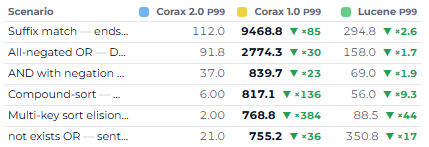
The technique I found most useful for confirming that the change is really mine is a little unusual. I had it build a harness that runs a set of scenarios against both the old version and the new one. It's a small app that issues queries and operations to the database and visualizes the results.

Here is what this looked like:

You can see that I have a bunch of scenarios that I’m testing, and it is very easy for me to track progress and know where I need to pay attention. The actual app had a lot more capabilities: what got faster, what got slower, the ranges, the memory used, everything and the kitchen sink went into that, in a format that made sense for the sort of work I was doing.

Each time I had a new direction, it was either driven by this application or I asked the model to add it to the application, so I could keep working on it. I kept working until nothing in the new version was slower than the old, and the headline paths were dramatically faster.

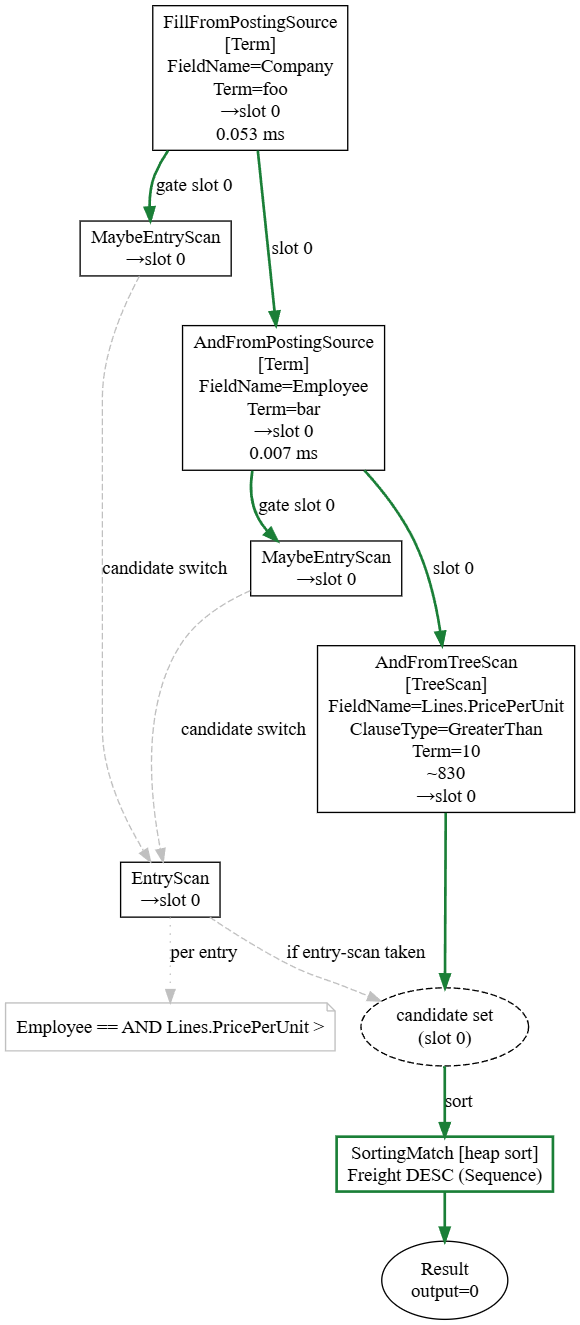
As an example of what this looked like most of the time, I ran a query, and then I inspected the structure we got back. Here is what some of that looked like:

And as I went, I kept changing the harness itself — show me this instead, group it that way. Trivial to do, because the harness is also throwaway. I'm not carrying it forward. I don't care about its code quality. I never even looked at its code. It exists to make a point, and once it's made the point, it's gone.

I also used the model to add introspection hooks and visibility into what was going on inside the system, surfacing stuff that you would usually have to scratch your head and debug to understand. That meant that I was able to look at a problematic query, then just look at its query plan and the timing in it. I usually knew where I needed to pay attention from there.

To be honest, that part feels a lot like cheating.


In the cases of the log analyzer and the comparison harness, the code is literally disposable. It’s scaffolding that would be thrown away after the work is done. I didn’t pay any attention to that code (I never read it), and it was never meant to be useful for anything else.

In the case of the production code, I went over each line of code so many times, I dreamt of it. A lot of the code there consists of annoying building blocks (building a visualization of the query plan as a graph, for example), which were sped up enormously by asking the model to build it for us. A lot of other code there is hand-crafted to say exactly what I needed it to.

But the fact that I can get good scaffolding from the model for cheap changes a lot of the usual considerations. Because scaffolding is literally disposable code, I don’t have to worry about the usual code quality concerns. The log analyzer would probably take two or three hours to write (without the pretty graphics, which were helpful for easily identifying what was going on).

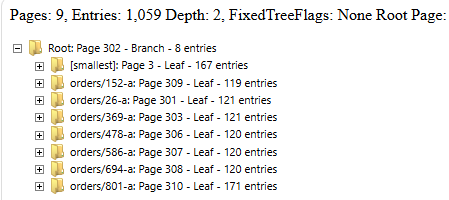
The comparison harness would be multiple weeks of effort and would probably be a non-interactive ASCII table. In fact, I don’t need to guess. Scaffolding isn’t something that is new, I do that all the time. Here is an example of one, written about a decade ago:

In the image above, you can find the internal structure of a B+Tree inside RavenDB. Contrast that with the following scaffolding for query plans. That one, by the way, is actually staying in the product.

Compare that to the level of insight that you can derive from the query plan higher up in this post. The B+Tree scaffolding, by the way, is essential to understanding the more complex scenarios. It paid for the time it took to write it many times over.

The ability to now effectively do the same at very little cost means that the act of building software itself is now easier. Not because someone else is writing the core code, but because everything else that we need to do is also easier.

FUTURE POSTS

  1. The cost of a free feature - one day from now

There are posts all the way to Jul 10, 2026

RECENT SERIES

  1. API Design (10):
    29 Jan 2026 - Don't try to guess
  2. Recording (20):
    05 Dec 2025 - Build AI that understands your business
  3. Webinar (8):
    16 Sep 2025 - Building AI Agents in RavenDB
  4. RavenDB 7.1 (7):
    11 Jul 2025 - The Gen AI release
  5. Production postmorterm (2):
    11 Jun 2025 - The rookie server's untimely promotion
View all series

Syndication

Main feed ... ...
Comments feed   ... ...